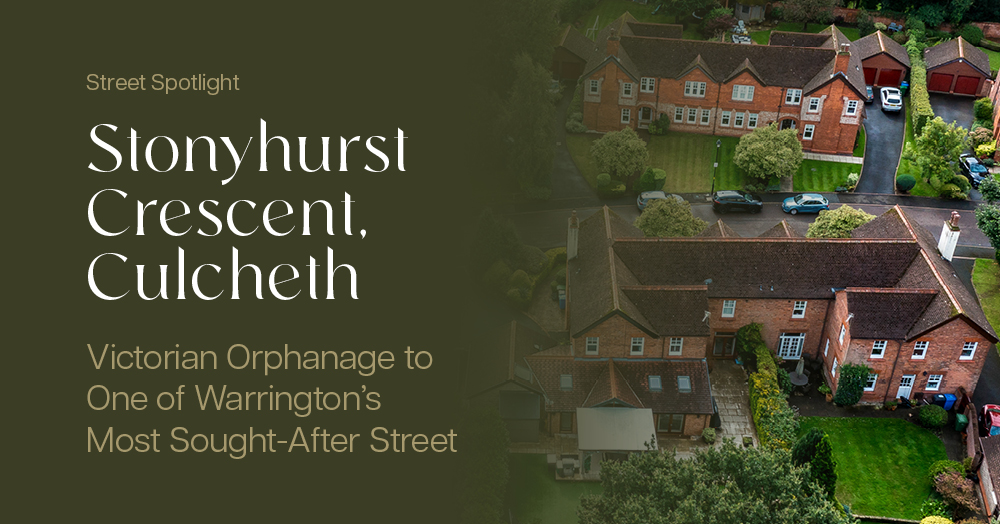
Stonyhurst Crescent, Culcheth: Victorian Orphanage to One of Warrington's Most Sought-After Street
Most streets have a history if you look hard enough. Stonyhurst Crescent in Culcheth has one that is genuinely remarkable. The homes that buyers compete for today, the large semi-detached Victorian properties with thick walls and generous proportions that sit along the crescent's distinctive oval layout, were not built as family homes at all.
They were built in 1903 as a Victorian institution for orphaned and destitute children. Understanding that history explains a great deal about why the street looks the way it does, and why the properties on it are so different from anything else in the village.

The Salford Cottage Homes, 1903
The story begins with the Salford Board of Guardians, the body responsible under the Poor Law for the care of children in the Borough of Salford. In the late Victorian period, the prevailing approach to housing children in care was shifting away from large institutional workhouses towards the 'cottage home' model: smaller residential units arranged in a village-like setting, where children would live in family groups supervised by house parents rather than in the regimented conditions of a traditional workhouse.
The Culcheth site was chosen for its rural character, well outside the urban sprawl of Salford, with open farmland and clean air that the reformers of the era considered essential for the health and development of children in care. The Salford Cottage Homes opened in 1903 on what is now Stonyhurst Crescent. The wider campus was extensive — the full Salford Union Cottage Homes colony comprised 22 semi-detached and two detached cottages across a multi-acre site, alongside an infirmary and administrative buildings. The fourteen units that survive today as Stonyhurst Crescent are specifically those arranged around the distinctive oval driveway, the section of the original campus that residents successfully campaigned to preserve in 1992.
The architecture was designed to match this ambition. The fourteen units were built to a consistent plan, with varied terracotta-detailed front elevations giving each a degree of individuality while the rears remained identical. The walls were built to an institutional standard, thick and solid in a way that residential construction of the period was not. The room sizes were generous by the standards of the time. These were buildings designed to last and to house dozens of children at a time, not modest family homes.
Because Culcheth fell under Lancashire County Council and then Leigh Rural District Council rather than Salford Borough, the homes were sometimes referred to as the Salford Union Cottage Homes to reflect the administrative relationship. The site was home to children from the Salford area, placed here to grow up in a rural environment far from the urban poverty that had brought them into care.
Newchurch Hospital and the threat of demolition
By the mid-twentieth century, the cottage homes had run their course as a children's institution. The site was repurposed as Newchurch Hospital, serving as a residential facility for people with physical and mental disabilities. For several decades the Victorian buildings continued to serve their institutional function, though in a very different capacity to the one for which they were designed.
When Newchurch Hospital closed in 1992, the question of what to do with the fourteen Victorian buildings became urgent. The straightforward answer, from a developer's perspective, was demolition. The buildings were old, they had been built for institutional use, and modern residential development on the site would have been far more profitable on a cleared plot.
Local residents disagreed. A campaign for preservation orders on the Victorian buildings gathered momentum, arguing that the architectural and historical character of the site was worth protecting. The campaign succeeded. Preservation orders were secured, the demolition plans were abandoned, and the fourteen buildings were instead refurbished and converted into semi-detached family homes. The conversion work was completed and the properties were sold to private individuals from 1995 onwards.
What the history means for the buildings today
The institutional origins of the buildings on Stonyhurst Crescent are not just historically interesting. They have direct, practical consequences for the homes that buyers are purchasing today.
The wall thicknesses are considerably greater than in standard residential construction of any era. Buildings designed to house dozens of children and staff in institutional conditions were built with a robustness that domestic housing simply did not require. Buyers who have purchased on the crescent consistently note the solidity of the structures.
The room sizes are exceptional. Each unit was designed as a group home rather than a family house, which means the internal proportions are generous in a way that reflects a completely different brief. Large reception rooms, wide corridors, and ceiling heights that reflect Victorian institutional construction rather than domestic economy are features that owners of these properties often highlight.
The plot sizes are substantial. The original cottage homes sat in generous grounds, and the 1995 conversion retained meaningful garden space for each of the resulting semi-detached properties. Combined with the oval layout of the crescent and the mature tree-lined approach, the streetscape has a character that is entirely its own within Culcheth.
The property market today
Stonyhurst Crescent is consistently cited as one of the most sought-after and expensive addresses in Culcheth and across the wider Warrington area. The Land Registry index average for the primary postcode area WA3 4DS sits at approximately £886,731, which is considerably above the Culcheth-wide average and places it in a different bracket to almost any other street in the village.
Recent Land Registry data reflects this clearly. Number 22 sold for £585,000 in October 2020. Number 32 sold for £685,000 in March 2019. Typical five-bedroom converted period homes on the crescent value in the £828,000 to £945,000 bracket today. Only heavily extended or significantly customised properties cross the £1,000,000 mark. It is also worth noting that the street is not exclusively large family homes — smaller terraced and mews-style properties on the crescent trade closer to £415,000, giving it a broader price range than many people assume.
Properties on Stonyhurst Crescent rarely come to market, and when they do they attract serious buyers who understand what they are getting. The combination of Victorian institutional construction, exceptional room sizes, large gardens, the distinctive oval setting, and the address itself creates a proposition that simply cannot be replicated elsewhere in Culcheth. There is nothing else quite like it in the village.
The street connects directly to Doeford Close and Eddisford Drive, both of which sit adjacent to the crescent and carry some of its prestige. The nearest primary school is Twiss Green Community Primary at approximately 500 metres, and Culcheth High School is 1.5 kilometres away. The location within Culcheth, between the village centre and the quieter residential fringe towards Common Lane, is well positioned for all the village amenities while maintaining the secluded character that has always defined the crescent.
A street unlike any other in Culcheth
What makes Stonyhurst Crescent genuinely unusual, beyond the architecture and the price point, is the layered history sitting beneath the surface of an ordinary residential street. The oval driveway that gives the crescent its distinctive layout was designed in 1903 to be approached by the children of Salford in horse-drawn carts from the station. The tree-lined avenue that buyers describe as part of the appeal today was planted at the same time, as part of a deliberate attempt to create a welcoming, park-like setting for children growing up in institutional care.
The thick walls, generous rooms, and solid construction that owners value today were built not for luxury but for institutional durability. The homes that now sell for the best part of a million pounds were designed to house orphaned children a hundred and twenty years ago. That history does not diminish the appeal of the street. If anything, for buyers who know it, it adds a depth of character that new build development can never manufacture.

If you own a property on Stonyhurst Crescent or in the surrounding area and are thinking about selling, we would be happy to tell you what it is worth right now. Call us on 01925 767000 or visit courtyardhomes.co.uk