The Risley Ordnance Factory: How 22,000 People Built Britain's Wartime Weapons on Your Doorstep
Drive through Birchwood today and you pass a business park, a forest park, a residential area, and a series of roads named after trees. It is quietly unremarkable in the way that most modern developments are.
But the land beneath it, and the park at its heart, carries one of the most significant industrial histories of any piece of ground in the North West. During the Second World War, on the very site where Birchwood Forest Park now stands, 22,000 people worked around the clock filling bombs, mines, and shells in one of the most dangerous factories in Britain.
Why Risley was chosen
In the mid-1930s, as the threat of another European war grew increasingly difficult to ignore, the British government began planning a network of new munitions factories. The three original Royal Ordnance facilities, at Woolwich, Enfield, and Waltham Abbey, were all in or near London and therefore dangerously exposed to bombing raids from the continent. New factories needed to be further north and west, away from the most vulnerable parts of the country, but close enough to centres of population to draw the large workforces they would require.
The site selected at Risley, between Warrington and Leigh, ticked every box. It was flat, largely heath and mossland, and sparsely populated. It was close enough to the industrial towns of Lancashire and Cheshire to access a substantial workforce. The railway connection through Glazebrook and the line through Culcheth gave transport access for workers and for the delivery of explosives in bulk. And there was one further factor that local people recognised at the time: the ground was almost always covered in low-lying mist and cloud. A local builder involved in the construction described it plainly: it was very lonely and misty at night, and that is why the factory was built there. It was hard to see it in the daytime.
The mist was not incidental. Natural camouflage from aerial reconnaissance was a genuine consideration in site selection. Risley's perpetual haze was an asset.
Construction and scale
The War Ministry compulsorily purchased 927 acres of land at Risley in 1939 and construction began in August of that year, just weeks before Britain declared war on Germany on 3 September. The scale of what was built is difficult to convey in modern terms. The site covered nearly one and a half square miles. It had its own internal road network, its own railway sidings connecting to the main line, its own telephone exchange, and its own street names. It was, in effect, a town built in secret.
The factory was designated Filling Factory No. 6. Its function was specific: it received explosives in bulk by rail from other Royal Ordnance Factories where the raw materials were manufactured, and it filled them into the finished munitions, the bombs, shells, and mines that would be used in the field. This was the most dangerous part of the entire production chain. Handling unstable high explosives, pouring molten TNT into shell casings, priming detonators, assembling finished munitions ready for dispatch; every stage carried a genuine risk of catastrophic explosion. Construction took 18 months to complete but production began in September 1940, before the site was fully finished, because the demand from the front was already urgent.
What they made
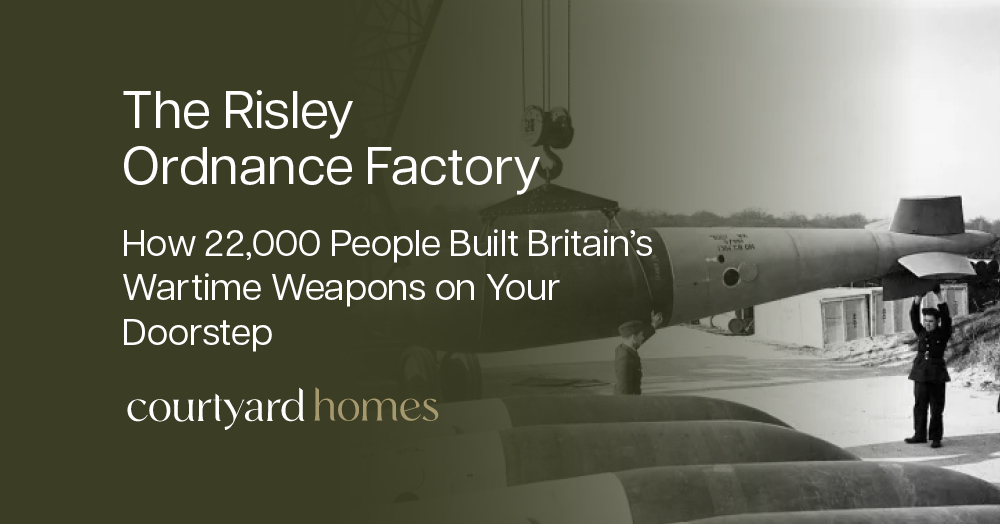
Over the course of the war, the workers at Risley filled one million mines and 500,000 bombs. Among the bombs produced here was the Grand Slam, a 22,000-pound high-explosive weapon designed by Barnes Wallis, the same engineer who created the bouncing bomb used in the Dambusters raid. The Grand Slam was the largest conventional bomb used by the RAF in the Second World War. It was designed as an earthquake bomb, dropped from high altitude to penetrate deep into the ground before detonating, collapsing the foundations of heavily reinforced targets including U-boat pens, railway viaducts, and V-weapon sites. The women and men who filled those casings at Risley were contributing directly to some of the most strategically significant bombing raids of the war.
The workforce: women at the front line
At its peak, around 22,000 people worked at Risley. The overwhelming majority were women. With men of fighting age conscripted into the armed forces, the filling factories across Britain ran almost entirely on female labour. These were not voluntary workers in most cases. Women were directed to the factories by the local Labour Exchange, given little choice about whether to go, and subject to the Official Secrets Act once they arrived. Mention of the factory was suppressed in the press. Maps of the period blanked the site out entirely.
The work was genuinely dangerous. The teams who handled the most volatile stages of the filling process were known informally as the Suicide Squad. There were accidents, injuries, and fatalities throughout the factory's operational years. Workers were required to wear specific uniforms designed to reduce the risk of static sparks, to remove all metal items before entering filling areas, and to observe strict protocols in handling materials that could detonate without warning. A cup of tea and two cigarettes in the canteen while clearing-up operations took place was apparently the standard response to an explosion in the magazine. The women had little alternative but to return to work.
Accounts recorded by the BBC's WW2 People's War project describe the daily reality in detail: the noise, the smell of explosive compounds, the exhaustion of long shifts, and the grim camaraderie that developed among workers who understood the risks they shared. Some accounts describe German planes flying over on speculative bombing runs, dropping incendiary flares to light up the sky for following aircraft. The women continued working.
What happened after the war
When the war ended in 1945, most of Britain's filling factories closed. Risley did not. In January 1946, the Directorate for Atomic Energy Production, operating under the Ministry of Supply, chose the former ordnance factory site as the headquarters for Britain's nascent nuclear weapons programme. The early atomic research used many of the existing ordnance factory buildings and retained the railway connection that had brought workers to the site during the war.
Under the direction of Sir Christopher Hinton, who oversaw the construction and engineering side of Britain's atomic programme, Risley became the design and planning centre for a series of nuclear installations across the country. In 1954, the United Kingdom Atomic Energy Authority was formally established with its headquarters at Risley. By 1961, more than 40,000 people were employed across the UKAEA's operations, the largest single concentration at the Risley site. The facility was conducting scientific research in physics, chemistry, and engineering at a level that placed it among the leading nuclear research establishments in the world.
The disused sections of the original ordnance factory site were placed on the market in 1963, the year before the last Culcheth train ran. No buyer came forward until 1968, when the Warrington Development Corporation, acting under government plans for the expansion of Warrington as a new town, purchased the site in preparation for building what would become Birchwood.
What survives today
Birchwood Forest Park now covers much of the land where the ordnance factory stood. The mounds visible throughout the park, including Pestfurlong Hill, were formed when the factory buildings were demolished in the late 1960s and early 1970s and the rubble used to shape the landscape. The park's main field sits roughly where Area 9, the munitions storage zone, once stood.
Four of the original concrete storage bunkers were not demolished. They remain in place today, standing in Birchwood Forest Park next to the playing fields. Most visitors walk past them without knowing what they are. They are the most tangible physical evidence remaining of what happened on this site between 1939 and the mid-1960s. The Walled Garden in the park was the former factory reservoir.
The land to the east of the park, where the UKAEA later built its headquarters and research buildings, became the nucleus of Birchwood Park business park, which today employs around 5,000 people in the science, engineering, and nuclear sectors. The connection between the wartime ordnance factory, the postwar atomic research establishment, and the current concentration of nuclear industry employers at Birchwood is direct and unbroken. The same land that produced the Grand Slam bomb went on to develop Britain's nuclear deterrent and now houses the companies that maintain it.
Not many business parks can claim that kind of history. Not many forest parks contain the remnants of a secret wartime factory. The next time you walk past those four concrete bunkers in Birchwood Forest Park, you are standing in the shadow of something genuinely significant.
Thinking about making Birchwood, Culcheth or the surrounding area your home? Courtyard Homes are your local property experts. Call us on 01925 767000 or visit courtyardhomes.co.uk